
Univ.-Prof. Dr. Wilfried Feichtinger
* 1950 † 2021 — From the first IVF baby to preimplantation genetic diagnosis to the depths of the human microbiome: Wilfried Feichtinger helped shape the milestones of reproductive medicine. On the history and future of human reproduction.
The world's first private fertility institute
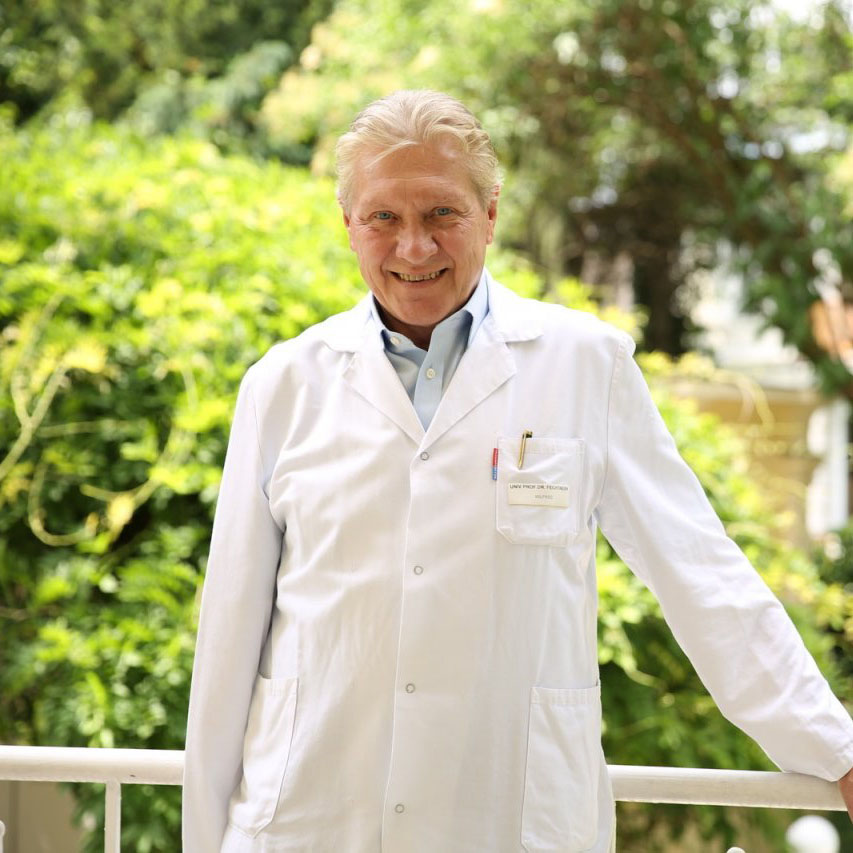
The Wunschbaby Institut Feichtinger was founded in 1983 by Professor Wilfried Feichtinger as the world's first private fertility institute. From then on he was regarded as a pioneer, and more than 15,000 children have been born since its founding thanks to treatments at the Wunschbaby Institut Feichtinger.
Austria's first successful in-vitro fertilisation
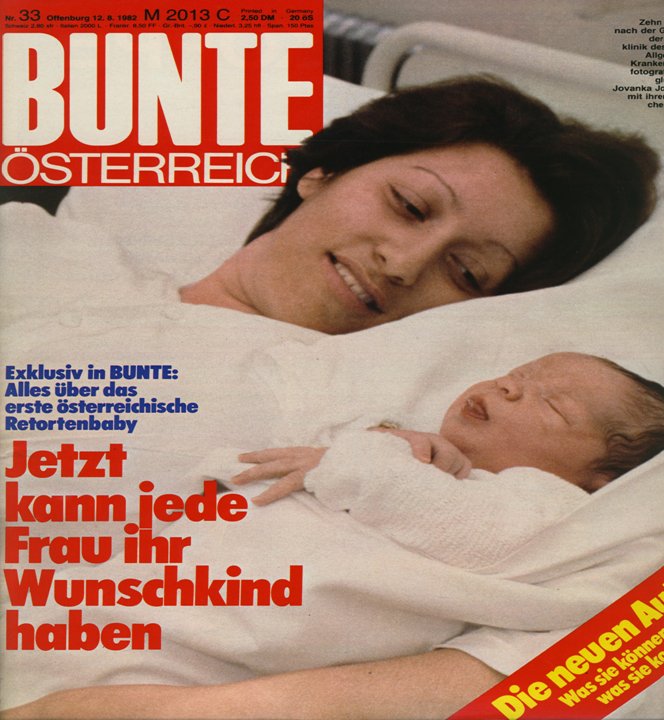
Univ.-Prof. Dr. Wilfried Feichtinger, founder of the Wunschbaby Institut Feichtinger, performed the first successful in-vitro fertilisation in Austria. Decades of international scientific collaborations and involvement in establishing fertility institutes in New York, Singapore, Budapest, Szeged, Győr, Moscow and Yekaterinburg shaped Professor Feichtinger's life. He put his language skills – including perfect Russian, English, Italian and French – to use in counselling couples from all over the world.
Methods that remain the global standard to this day
Professor Feichtinger was, among other things, an expert in selecting the appropriate ovarian stimulation, in the woman's natural (unstimulated) cycle, and in the treatment of men within reproductive medicine.
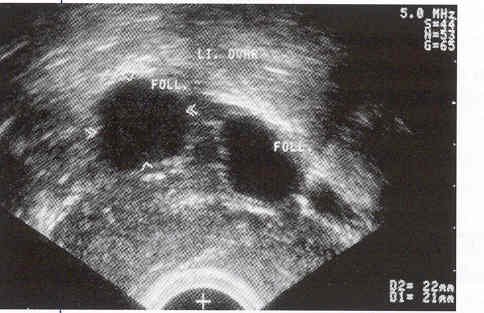
He also developed the simple ultrasound-guided egg retrieval (today the method of choice worldwide) and was the inventor and co-developer of vaginal sonography (ultrasound examinations through the vagina).
From preimplantation genetic diagnosis to the microbiome.
Preimplantation genetic diagnosis
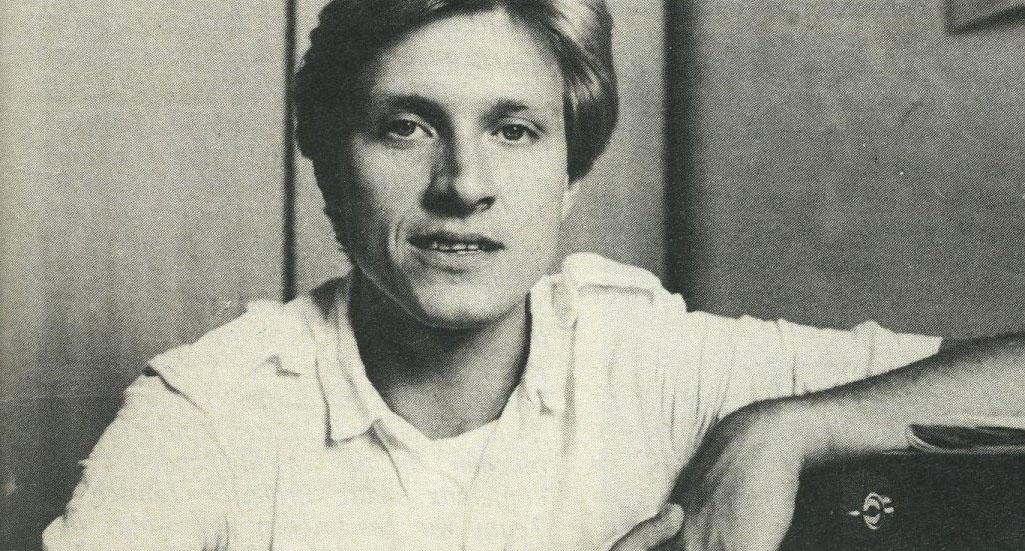
Preimplantation genetic diagnosis, now routinely performed, is pioneering work by Wilfried Feichtinger, who was a trailblazer in carrying out genetic testing on unfertilised and fertilised eggs.
Microbiome research
Through microbiome analysis of the female genital tract, Feichtinger provided some of the very first evidence of the microbiome's significance for female and male infertility (microbiome = the colonisation of the body with "good" and "bad" bacteria).
"Kinderwunsch und Lebensplan"
His book "Kinderwunsch und Lebensplan" has already been published in a second revised edition and also appeared in English under the title "The Success Rates and Limits of Reproductive Medicine: Wanting Children and Planning Your Life" with Cambridge Scholars Publishing in England. In his book, Feichtinger emphasised that the wish for a child should be planned, especially by women pursuing a professional career, and that women should not wait too long.
Austria's figurehead of reproductive medicine
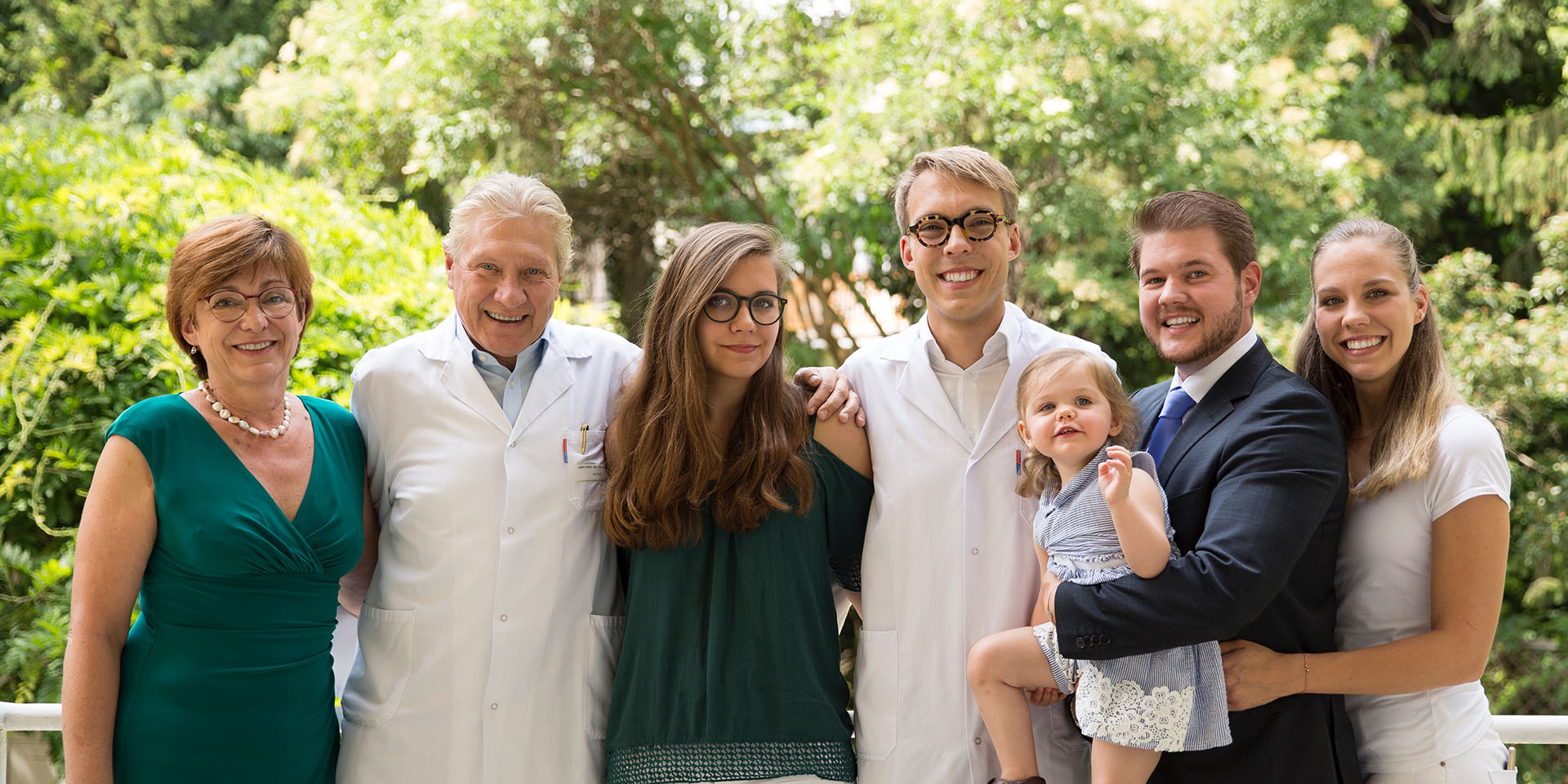
It can be stated without doubt that Univ.-Prof. Dr. Wilfried Feichtinger was Austria's figurehead of reproductive medicine. After a serious illness, he is survived by 7 children, 7 grandchildren and his wife Brigitte, to whom he was happily married for over 30 years.
From medical student to IVF pioneer.
Wilfried Feichtinger was born in Vienna on 19 October 1950. On his mother's side he was the son of Russian immigrants; his grandfather was a Russian nobleman. Feichtinger's father studied international trade and worked as an accountant. His mother gave German lessons to officers of the Russian army during the Allied occupation.
The path into medicine
Feichtinger grew up bilingual, partly with his Russian grandmother, where he learned to speak, read and write Russian. After his school-leaving exams, he considered becoming a lawyer, a pilot or a physician. His Austrian grandmother, a civil servant, remarked: "No doctor has ever starved!" His neighbour took him along to a lecture by the legendary anatomist Professor Walter Krause – and the decision to study medicine was made.
During his studies, there were two gynaecology placements at the Women's Hospital of the University of Vienna. There he had to observe operations and births. This convinced him to become a gynaecologist – above all, he was fascinated by the creation of life. While still a student, Feichtinger registered at the Women's Hospital, as the waiting list for a training position was very long. Prof. Peter Husslein invited him to an interview and was thrilled by Feichtinger's interest in IVF treatments.
After 12 semesters, on 16 May 1975, Feichtinger received his doctorate and began his residency in Baden as early as 20 May 1975. He completed it in September 1978 and took up his post at the Women's Hospital of the University of Vienna. In the summer of 1978, Louise Joy Brown, the world's first test-tube baby, was born. From that moment on, IVF treatments were Feichtinger's main focus and great passion.
Setting out into IVF
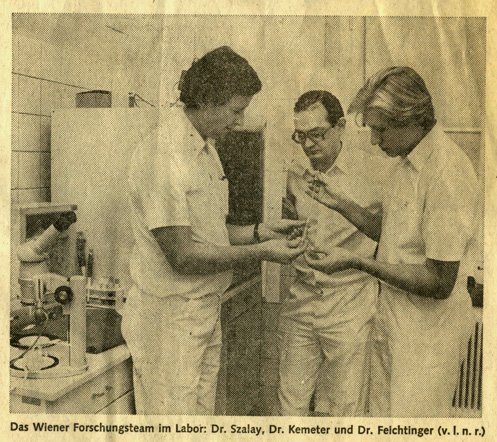
After a stay at the Royal College of Obstetricians and Gynaecologists in England, Feichtinger presented the method behind the world's first successful IVF treatment at a lecture in Vienna. Prof. Husslein enabled him to pursue the path of IVF in Vienna. With Husslein's support, Feichtinger applied to the Research Promotion Fund to establish an IVF unit at the Women's Hospital. With the fund's resources, he was able to assemble a team, which he led until 1983. After the first successful IVF births, Feichtinger set up on his own and founded his private institute.
While still training at the Women's Hospital, Feichtinger spent several weeks in Togo, Africa – as part of a research project aimed at introducing the Austrian mother-child health passport there. In Togo, Feichtinger was confronted with every form of obstetrics and the most dreadful situations, which made him an expert obstetrician.
In the mid-1980s, Feichtinger developed the vaginal scanner with the Austrian company Kretztechnik, which brought him international recognition and invitations to perform treatments worldwide. From then on, eggs were retrieved through the vagina using Feichtinger's method.
In 1983, Feichtinger founded the Wunschbaby Institut Feichtinger in Vienna, which today is held in high international regard and has brought more than 15,000 babies into the world. The institute is now led by his son, Priv.-Doz. DDr. Michael Feichtinger – an institution by family, for family. Over the course of his career, Feichtinger published numerous scientific papers and books.
Private life
Univ.-Prof. Dr. Wilfried Feichtinger was married to Brigitte, father of 7 children and grandfather of 7 grandchildren.
He met his first wife Christl at the enrolment advisory service of the University of Vienna. With her he had his first son, Wolfgang, in 1977. Wolfgang holds an engineering degree, is a garden designer and specialises in rooftop terraces.
In 1979, Feichtinger fell in love with medical student Karin and subsequently divorced Christl. The two married in 1980, and their son Georg was born in 1981. Daughter Sonja followed in 1983. She lives in Vancouver and is a lawyer specialising in EU law; she married a Canadian tax advisor.
On the return journey from a congress to Vienna, Feichtinger met his future wife Brigitte, who was on board as a flight attendant. The two had already known each other as children through their parents – it became the love of a lifetime.
Karin and Feichtinger separated in 1985. From his relationship with Brigitte, son Michael was born in 1987, followed a year later, in 1988, by daughter Katharina. She now lives in Carinthia and is a social worker.
In 1988, Feichtinger took up a visiting professorship at the Albert Einstein College of Medicine, and the family lived in New York for several months. There, Feichtinger successfully established IVF, and the first New York test-tube baby was born. In 1987, Feichtinger was also responsible for the first IVF birth in Singapore.
Daughter Lisa was born in 1990. She is a trained geneticist and also works at the Wunschbaby Institut. Lisa is married to Christian Wallner, the commercial director of the Wunschbaby Institut Feichtinger.
Daughter Susanna was born in 1999. She studies medicine at the Sigmund Freud University in Vienna, is also a paramedic and works at the Wunschbaby Institut Feichtinger alongside her studies.
Feichtinger was an enthusiastic singer and performed several times at the Neuwaldegg Opera Festival in the role of Prince Malcolm in Giuseppe Verdi\'s opera Macbeth. In 2014, he gave a solo performance at the Wiener Stadthalle at a charity event for children with special needs.
One of Feichtinger\'s great passions was travelling. Near the Semmering, Feichtinger ran a small hobby farm, where he spent a great deal of time with his family and loved to cook – above all Russian cuisine.
Over 10,000 births
Wilfried Feichtinger fulfilled the wish for a child of over 10,000 couples. His legacy lives on for all time in the hearts of countless children and their children's children.
We fulfil your wish for a child!
The next generation carries on his life's work – book a first consultation or join a free info evening.
Or call us: +43 1 877 77 75