

Ferticheck Female – assessing female fertility.
With a few simple tests we can determine your fertility! In the Western world, having children is being postponed further and further for a wide variety of reasons – and many women worry about their fertility as a result.
With increasing age, the ovarian reserve declines sharply. In addition, tubal adhesions can develop over the course of life as a result of inflammation or surgery, blocking the transport of sperm cells to the egg or of embryos into the uterus.
Especially when the wish for a child is only considered from the mid-30s onwards, couples should know about their fertility as early as possible. You will find an overview of all the possible reasons for an unfulfilled wish for a child on our causes page.
The hormone status at the beginning of the cycle.
A woman's hormonal cycle is a sensitive, finely tuned system in which several hormones play an essential role. These hormones are produced in the brain, the thyroid gland, the ovary and the adrenal cortex. Even minor deviations can make a pregnancy more difficult, which is why one of the first steps of a fertility work-up is usually the hormone status at the beginning of the cycle (i.e. during the first days of your period).
From this hormone status, conclusions can be drawn about the function of the ovaries, the thyroid gland and the pituitary gland. If you would like to have a hormone status done with us, simply get in touch for a blood test appointment when your period starts.

The ovarian reserve – AMH.
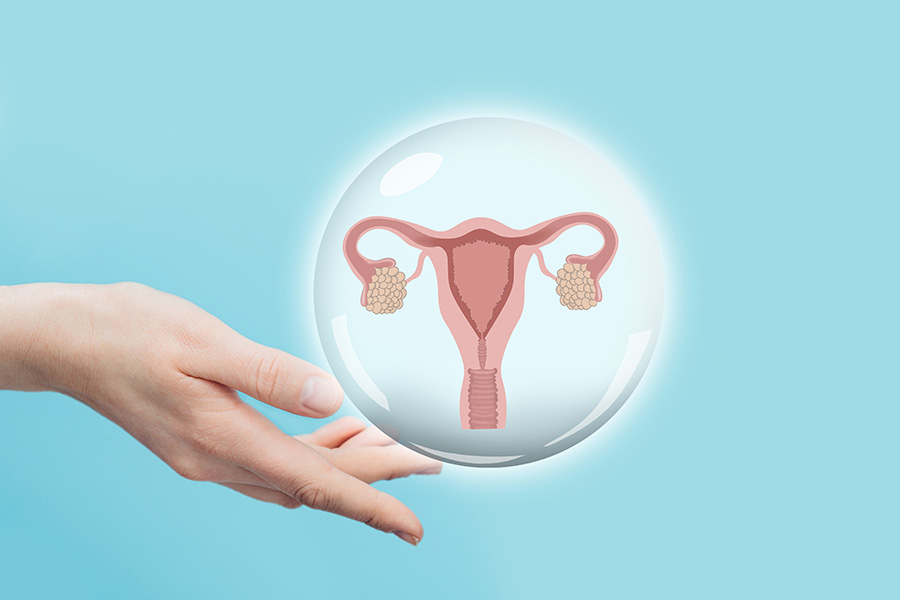
Every woman is born with her ovarian reserve, which is gradually used up over the course of her life. With every menstrual cycle, several follicles set off on their journey, of which one prevails. The simplest indicator of a sufficient ovarian reserve is a regular cycle: particularly short or long intervals from one period to the next can be a sign of a reserve that is too low or too high. Your gynaecologist can also draw conclusions about the ovarian reserve by counting the antral follicles – the follicles on the ovary that are ready to grow.
The most precise way to determine the ovarian reserve, however, is with the anti-Müllerian hormone – AMH. Through this blood test, a woman receives exact information about how high her ovarian reserve is and thus "how full" the ovary still is. This is particularly relevant for women who wish to have children, as well as for women with previous abdominal surgery, endometriosis or PMOS (formerly PCOS) – all conditions that affect AMH. The AMH level also helps us estimate how many eggs we can expect to retrieve in the course of fertility treatment. You are welcome to have your AMH measured at our institute by appointment – on any day of your cycle.
Tubal patency – HYCOSY.
A blockage of the fallopian tubes means that the connection between the uterus and the ovary is permanently interrupted: no sperm cells can reach the egg, and fertilised eggs cannot reach the uterus to implant.
There are several reasons why fallopian tubes are blocked. Often, unnoticed infections in the past (e.g. from chlamydia) are the cause, but endometriosis and congenital malformations can also lead to a tubal blockage.
Unfortunately, a woman cannot tell whether her fallopian tubes are open or not, as a blockage causes neither pain nor any other symptoms. Blocked fallopian tubes are also not visible on a normal gynaecological ultrasound. To determine patency, a fluid that is visible on ultrasound is flushed through the fallopian tubes using a thin catheter.
This examination is called HYCOSY (hysterosalpingo-contrast sonography) and is completely painless for most women. You are welcome to have a HYCOSY done at our institute – we need up-to-date vaginal infection swabs for this. The examination is usually carried out in the first half of the cycle, and thanks to a certain "flushing effect", fertility is actually slightly increased in the first months after the examination.
Female fertility and age: why time is a factor.
A woman's most fertile phase of life is between the ages of 20 and 30. From around the mid-30s, fertility declines noticeably – not only because the ovarian reserve becomes smaller, but also because the proportion of eggs with chromosomal changes increases. This explains why, with increasing age, both the likelihood of a pregnancy per cycle decreases and the risk of miscarriage rises.
This does not mean that a pregnancy from 35 onwards is unlikely – but it does mean that an early work-up is all the more valuable. If you consciously want to postpone having children, you can take precautions by freezing eggs (cryopreservation). And if you are currently trying to get pregnant, you will find practical tips in our guide Getting pregnant – from your fertile days to lifestyle.
Improving your fertility: what you can do yourself.
Even though the ovarian reserve cannot be enlarged – you can actively influence the conditions for a pregnancy. A normal body weight supports the hormonal balance: both marked overweight and underweight can disrupt ovulation. Avoid nicotine as far as possible, as smoking damages the eggs and can accelerate the onset of menopause, and reduce alcohol. Taking folic acid is also recommended as soon as you are trying for a baby.
And finally: do you know your fertile days? The chance of a pregnancy is highest on the days around ovulation. If it has not worked out after a year despite good timing – or after six months from the age of 35 – the right time for a work-up has come. At a first fertility consultation or one of our free fertility info evenings, we answer all your questions – with no obligation.
Book your appointment now
Book your appointment to assess your fertility at the Wunschbaby Institut Feichtinger – by phone on +43 1 877 77 75 or via our contact form. By the way: there is also a simple check for men – the semen analysis.
Female fertility: your questions.
Which examinations does the Ferticheck Female include?
The Ferticheck Female consists of three building blocks: the hormone status at the beginning of the cycle, determination of the ovarian reserve via the AMH level, and a check of tubal patency using HYCOSY. Together, these examinations provide a meaningful picture of your fertility.
When in the cycle should the hormone status be done?
The hormone status is ideally taken at the beginning of the cycle, i.e. during the first days of your period. Simply get in touch for a blood test appointment when your menstruation starts. The AMH level, on the other hand, can be determined on any day of the cycle.
Is the HYCOSY examination painful?
For most women, the HYCOSY is completely painless – some feel a brief, period-like pulling sensation. The examination takes only a few minutes and usually takes place in the first half of the cycle. All we need for it are up-to-date vaginal infection swabs.
How quickly will I receive my results?
Since we have our own hormone laboratory, the hormone and AMH results are usually available quickly. You can even see the result of the HYCOSY immediately on the ultrasound image during the examination. We then discuss all findings with you in detail.
Can my fertility be reduced despite a regular cycle?
Yes. A regular cycle is a good sign, but it does not rule out blocked fallopian tubes, for example – these cause no symptoms at all. And in around half of all cases, a cause lies (also) with the partner, which is why a semen analysis in parallel always makes sense.
When should I have my fertility assessed?
If you are under 35 and have been trying to get pregnant for a year without success – from 35, after just six months. Independently of this, the Ferticheck Female makes sense for all women who are postponing family planning and want to know how their fertility stands.
What happens if a result is abnormal?
Then we calmly discuss what the result means and which paths there are – from simple measures and insemination to IVF. An abnormal value is not a verdict, but the basis for a targeted, individual treatment plan.
We fulfil your wish for a child!
A few simple tests are enough to gain clarity about your fertility – we are at your side along the way.
Or call us: +43 1 877 77 75