

"Chipsi" – sperm selection with the Fertile Chip©.
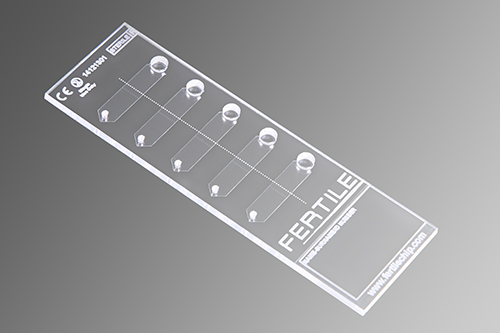
As the first institute in Austria and one of the first in Europe, we at the Wunschbaby Institut Feichtinger offer the new Fertile Chip© for selecting the sperm best suited for fertilisation.
Help with reduced semen quality
Through its microstructure, this technology imitates the natural migration of sperm towards the egg, enabling a gentle selection of vital sperm of high genetic and physiological quality. The technique can be used for sperm selection both as part of assisted fertilisation and for insemination.
The Fertile Chip© is not a treatment of its own, but an additional step in the laboratory. Nothing changes about the course of your treatment – the difference arises at the moment when it is decided which sperm are used for fertilisation.
How the microchip technology works.
The basic idea: we do not pick out the sperm – the sperm themselves show what they are capable of.
The sperm make the journey themselves
Inside the chip there are extremely fine channels. The sperm sample is introduced on one side; to reach the other side, the sperm have to migrate through this microstructure under their own power. In its principle, this migration corresponds to the path sperm travel in the body from the cervix to the fallopian tube. At the end of the course, those sperm gather that were actually capable of it – selected not by appearance alone, but by their function.
Gentle instead of spun
In classic sperm preparation, the sample is centrifuged. This is established and proven, but it means mechanical strain. The Fertile Chip© does without this step: the selection happens solely through the sperm's own movement. The aim is to obtain sperm with DNA as intact as possible and good motility for fertilisation – and to keep the strain on the cells during preparation as low as possible.
Male fertility has declined by 50%
Since the 1970s, sperm quality and quantity have declined by more than 50%. Unlike the decline in female fertility, this decrease is independent of age. Likewise, the average age at first fatherhood has been rising rapidly in the Western world since the 1970s (see Medical Tribune, 16/18).
DDr. Michael Feichtinger counters this phenomenon with the new Fertile Chip©.

Because of the strong influence of female age on fertility, male age and sperm quality were neglected for a very long time. With state-of-the-art microchip technologies such as the Fertile Chip©, we at WIF can significantly and positively influence this male factor.
Director, Wunschbaby Institut Feichtinger
When we consider the Fertile Chip©.
We use the selection in a targeted way – when the male factor plays a role or previous treatments speak for it.
Typical starting situations
A conversation about the Fertile Chip© is particularly close at hand when
- the semen analysis shows reduced motility or a high proportion of malformed sperm,
- there are indications of increased DNA fragmentation of the sperm,
- the man is of more advanced age or lifestyle factors such as nicotine have had a long-term effect,
- in previous cycles noticeably few eggs were fertilised or the embryos developed hesitantly,
- there have been repeated unsuccessful treatments or early miscarriages,
- despite a comprehensive work-up, no cause has been found.
Also possible with insemination
An essential difference from other selection procedures: the Fertile Chip© can be used not only with IVF and ICSI, but also with insemination. Precisely where we cannot further control what happens in the body, the quality of the sperm placed there can count all the more.
The prerequisite is that enough motile sperm are present to migrate through the microstructure. With very severely reduced findings – for example, when only single sperm are found – this principle is not applicable; in that case, our embryologists select the sperm directly under the microscope. We tell you beforehand what is possible in your case.
Selection with the Fertile Chip© step by step.
The selection takes place in the laboratory on the day of fertilisation and does not prolong your treatment.
Sperm collection
The sperm sample is provided on the day of egg retrieval or of the insemination – usually after two to three days of abstinence. In exceptional cases it is possible to bring the sample from home; it must not be older than two hours.
The sample goes onto the chip
Instead of classic centrifugation, the sample is introduced into the Fertile Chip©. There, a system of extremely fine channels is open to it – the microstructure modelled on the natural path of the sperm.
The sperm migrate
Now the sperm themselves take over: only those that are sufficiently vital and motile make it through the channels to the target area. This self-selection is the core of the method – nothing is spun, pressed or chemically treated.
Retrieval and assessment
From the target area, the sperm that have arrived there are retrieved and assessed under the microscope. For an ICSI, our embryologists select a single sperm from them – the pre-selection by the chip narrows the field to the most promising candidates.
Fertilisation and further course
The treatment then continues unchanged: fertilisation in the laboratory, observation of embryo development, embryo transfer – supplemented where needed by laser-assisted hatching support (assisted hatching) – and medicinal support of the implantation phase. With an insemination, the selected sperm are placed directly into the uterus.
Advantages – and what the chip cannot do.
We consider it part of good counselling to assess additional procedures realistically.
What speaks for the Fertile Chip©
The selection is gentle because it works without centrifugation and without chemical additives. It follows one of the body's own principles – the migration of the sperm towards the egg – and thus selects by function instead of appearance. For the patient, the step means no additional strain: no further medication, no additional appointments, no prolongation of the treatment. And the method has a broad range of use, from insemination to ICSI.
Where the limits lie
The chip improves the selection – not the sperm themselves. If semen quality is fundamentally severely reduced, that remains a factor that even good selection cannot remove. Likewise, it has no influence on egg quality, which depends on the age of the woman, and none on implantation in the uterus.
For the benefit of sperm selection procedures there are indications from studies, but no guarantee for the individual case. We use the Fertile Chip© where there is a comprehensible rationale – and tell you openly if other factors are in the foreground. You will find an overview of all methods under fertility treatments.
How the Fertile Chip© interacts with other methods.
Fertile Chip© or PICSI?
Both procedures look for sperm with DNA as intact as possible, but use different principles for it: the chip relies on migration through a microstructure, PICSI on the binding of mature sperm to hyaluronic acid. What fits better is decided by the findings – not by the technology.
With ICSI and IVF
After fertilisation
Once fertilisation has taken place, embryo development and implantation determine the further course. Here, extended culture to the blastocyst stage and – with a hardened outer shell – assisted hatching can be useful additions.
Lifestyle and prevention.
Smoking damages fertility
The fact is that semen quality also declines with increasing age; DNA fragmentation and oxygen radicals in the sperm increase. This is significantly accelerated by lifestyle factors such as nicotine abuse.
The semen analysis as a standard check
Prof. Wilfried Feichtinger, founder of the institute and "medical father" of the first test-tube baby in Austria, emphasises:
"Just as a hormone status is routinely performed for women, a semen analysis should be performed by every man – even without a current wish for a child – to determine the current state of his sperm quality. The effort and cost are relatively low compared with the information gained."
New procedures – put into perspective with experience
The Wunschbaby Institut Feichtinger was the first institute in Austria to offer the Fertile Chip©. This role is not new to us: since 1982/83 we have been a pioneer of reproductive medicine in Austria, the first Austrian IVF baby was born here, and in 1993 ICSI was introduced in Austria by the WIF. More than 30,000 births have resulted from treatments with us.
New technology alone is not enough, however – it has to fit the findings. Because we have our genetics and hormone laboratory in-house, we can bring diagnostics, laboratory procedures and treatment plan directly together: 360 degrees under one roof, at our locations in Vienna, Baden and St. Pölten. State of the art where it helps you – and honest restraint where an additional procedure brings no recognisable advantage. We are family: we treat you the way we would treat our own family.
Frequently asked questions about the Fertile Chip© ("Chipsi").
What is the Fertile Chip© in one sentence?
The Fertile Chip© is a microchip with extremely fine channels that the sperm have to migrate through under their own power. Because this structure imitates the natural migration towards the egg, it is above all vital, well-motile sperm that reach the target area – and from these, the ones for fertilisation are selected.
What does the name "Chipsi" stand for?
"Chipsi" is the short form commonly used in everyday language for sperm selection with the Fertile Chip© – analogous to "ICSI" or "PICSI". It always means the same procedure: the selection of sperm via microchip technology before fertilisation.
What is the difference between the Fertile Chip© and PICSI?
Both procedures select sperm by functional properties, but go about it differently. With the Fertile Chip©, the sperm have to migrate through a microstructure. With PICSI, mature sperm bind to a coating of hyaluronic acid – the substance that also surrounds the egg. Which procedure is more suitable in your case is something we decide on the basis of the semen analysis.
Is the Fertile Chip© also possible with an insemination?
Yes. That is an advantage of this method: it can be used with IVF and ICSI as well as with insemination. The prerequisite is that enough motile sperm are present to migrate through the channels.
Will I notice anything of it as a patient?
No. The selection takes place exclusively in the laboratory, after the sperm sample has been provided. No additional medication, no further procedures and no additional appointments are needed for it, and the treatment does not take longer as a result.
Who is the method particularly interesting for?
Above all when the male factor plays a role: reduced motility or morphology in the semen analysis, indications of DNA fragmentation, more advanced age of the man, noticeably low fertilisation rates in an earlier cycle or repeated unsuccessful treatments.
Does the Fertile Chip© replace a semen analysis?
No. The semen analysis is the basis on which we can decide at all whether a selection makes sense – it describes the number, motility and shape of the sperm. The chip is a procedure for selection as part of the treatment, not an examination. The two belong together.
Does sperm selection guarantee a pregnancy?
No, and we would not hold that out in prospect either. The selection can improve the quality of the sperm used for fertilisation; it has no influence on egg quality, embryo development or implantation. It is a building block that can support the chances – not a certainty.
Is the Fertile Chip© right for you?
In a personal consultation we will clarify whether sperm selection with the Fertile Chip© is a useful addition to your treatment.
Or call us: +43 1 877 77 75