

AMH: determining the ovarian reserve.
Every woman is born with her ovarian reserve, which is gradually used up over the course of her life. The AMH level reveals "how full" the ovary still is – a key piece of information for your family planning.
What your cycle reveals about your ovarian reserve.
With every menstrual cycle, several follicles set off on their journey, of which one prevails. The simplest indicator of a sufficient ovarian reserve is a regular cycle: particularly short or long intervals from one period to the next can be a sign of a reserve that is too low or too high.
Your gynaecologist can also draw conclusions about the ovarian reserve by counting the antral follicles – the follicles on the ovary that are ready to grow.
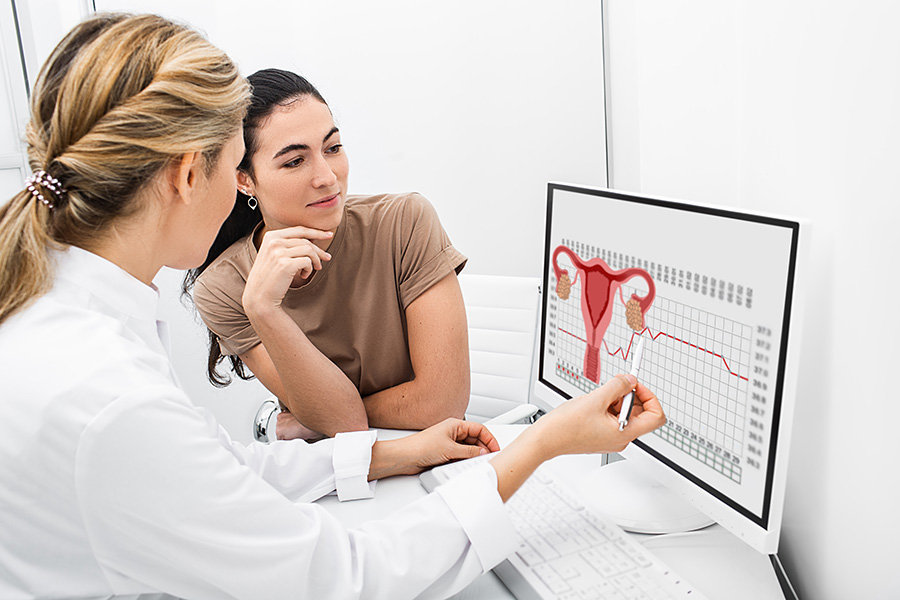

The anti-Müllerian hormone (AMH).
The most precise way to determine the ovarian reserve is with the anti-Müllerian hormone – AMH. Through this blood test, a woman receives exact information about how high her ovarian reserve is and thus "how full" the ovary still is.
This is particularly relevant for women who wish to have children, as well as for women with previous abdominal surgery, endometriosis or PMOS (formerly PCOS) – all conditions that affect AMH. The AMH level also helps us estimate how many eggs we can expect to retrieve in the course of fertility treatment.
You are welcome to have your AMH measured at our institute by appointment – on any day of your cycle.
What the AMH level tells you – and what it does not.
The anti-Müllerian hormone is produced by the small, growing follicles in the ovary – the more follicles there are, the higher the level. The AMH level is therefore the most reliable measure of the quantity of remaining eggs. What it does not measure is the quality of the eggs. That depends primarily on age – a 35-year-old with a low AMH level has better chances per egg than a woman over 40 with the same level.
A low AMH level therefore does not mean that a spontaneous pregnancy is impossible: for the natural way, a single mature egg per cycle is enough. It does mean, however, that the window of time is getting smaller – and is thus an important signal not to postpone family planning any further. Good to know: hormonal contraception can temporarily lower the measured level somewhat, whereas with PMOS it is typically elevated.
Low AMH level: what you can do now.
A low level is no reason to panic, but a reason to act. If you are currently trying for a baby, this means: a prompt, complete work-up of both partners – including a semen analysis – and, if necessary, early fertility treatment, for example with IVF. The AMH level helps us tailor the hormonal stimulation precisely to you.
If having children is not yet on your agenda, freezing unfertilised eggs as a precaution (social freezing) can be an option to preserve today's egg quality for later.
Can the ovarian reserve be improved?
The number of eggs is fixed from birth – new eggs cannot be formed, and no medication can replenish the reserve. What you can influence are the conditions: giving up nicotine is the most effective single measure, because smoking accelerates the loss of eggs. An overall healthy lifestyle also supports egg maturation.
With a very low reserve, individually tailored stimulation concepts are used in IVF. Our team will discuss openly and realistically with you which path offers the best chances in your situation – true to our 360° care approach.
More on assessing your fertility.
The AMH level is one building block of a comprehensive fertility work-up. You can read all about hormone status, ovarian reserve and tubal patency under Ferticheck Female – assessing female fertility. Our page on the causes of infertility provides an overall overview.
Book your appointment now
Book your appointment to determine your ovarian reserve at the Wunschbaby Institut Feichtinger – by phone on +43 1 877 77 75 or via our contact form.
AMH level and ovarian reserve: your questions.
When should I have my AMH level tested?
Testing is advisable if you are trying for a baby, before freezing eggs as a precaution and before surgery on the ovaries, for example for endometriosis. Anyone who wants to postpone family planning also gains an important basis for decision-making with the AMH level. The blood test can be done on any day of the cycle.
What is a "normal" AMH level?
The AMH level naturally decreases with age – a level that would be unremarkable at 40 can be strikingly low at 28. It is therefore always interpreted in the context of age, cycle and ultrasound findings. We will discuss your personal level with you in detail.
Does a low AMH level mean I cannot get pregnant?
No. The AMH level measures the quantity, not the quality of the eggs – and for a natural pregnancy, one mature egg per cycle is enough. A low level does mean, however, that the window of time is getting smaller, and argues for not postponing your wish for a child.
Does the pill affect the AMH level?
Hormonal contraceptives can temporarily lower the measured AMH level somewhat, as the ovaries "rest" while on the pill. After stopping, the level usually recovers. Please tell us if you are using hormonal contraception – we take this into account in the interpretation.
What does a high AMH level mean?
A high level indicates a large ovarian reserve. Markedly elevated levels can point to PMOS and mean an increased risk of overstimulation during hormonal stimulation – in which case the dosage is chosen with appropriate caution.
How does the AMH test work at the Wunschbaby Institut Feichtinger?
You simply book an appointment for a blood test – on any day of your cycle. The analysis is carried out in our own hormone laboratory, and afterwards we discuss the result together with you, including the question of which steps make sense in your situation.
Can I have IVF with a low AMH level?
Yes. The AMH level helps us dose the stimulation individually and discuss realistic expectations – with a low reserve, fewer eggs are usually retrieved. With specially adapted stimulation concepts, we get the best out of your personal starting position.
We fulfil your wish for a child!
A simple blood test brings clarity about your ovarian reserve – the first step is the most important one.
Or call us: +43 1 877 77 75