

Unfertilised eggs
After hormonal stimulation and egg retrieval, mature eggs are vitrified. In Austria, this is tied to a medical indication.
Cryopreservation means the freezing of cells in liquid nitrogen at −196 °C.
A special cryopreservation procedure makes it possible to freeze embryos and sperm and store them over a longer period of time. In Austria, under the Reproductive Medicine Act, fertilised eggs and sperm may be stored – until revoked by the woman or the man – but for a maximum of 10 years.
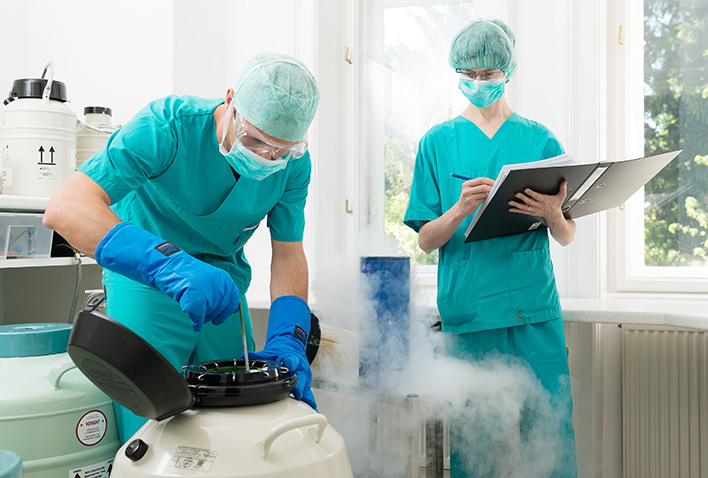
At −196 °C, all metabolism stands still. Cells do not age further in this state – an egg frozen today still has today's biological quality even after years. That is the real gain of cryopreservation: it fixes the point in time at which the cell was obtained.
The challenge lies not in the cold itself, but in the water inside the cell. If it froze into ice crystals during cooling, these would destroy the delicate cell structures. That is why the cell water is gradually replaced with cryoprotectant solutions before freezing.
In classic slow freezing, the temperature is lowered in controlled steps. In vitrification – today the method of choice for eggs and blastocysts – the opposite happens: the cells are cooled so rapidly, within seconds, that the cell interior solidifies into a glass-like state without forming crystals. "Vitrum" is the Latin word for glass.
The cells are kept in clearly labelled carrier systems in nitrogen tanks. Assignment, documentation and the monitoring of the tanks follow fixed laboratory routines – every sample can be assigned to a patient at any time. Thawing is carried out just as rapidly and in as controlled a manner as freezing.
Depending on which cells are preserved, the procedure, timing and legal framework differ.
After hormonal stimulation and egg retrieval, mature eggs are vitrified. In Austria, this is tied to a medical indication.
Viable embryos from an IVF or ICSI treatment that are not transferred are frozen and remain available for a later transfer.
Sperm samples can be frozen without complication – for example before cancer therapy, before a vasectomy, or if the partner cannot be present on the day of egg retrieval.
If there are no sperm cells in the ejaculate, tissue can be retrieved from the testicle and preserved – so no new procedures are needed for further cycles.
From the consultation to the frozen embryo transfer, we accompany you through every step – in our own laboratory, without transport routes for your cells.
We clarify your personal situation, the medical background and the legal framework. You learn which cells can be preserved in your case and what that means for your further planning.
Every preservation is preceded by the necessary blood and infection tests. If egg retrieval is planned, hormone values and an ultrasound check of the ovaries are added.
Eggs are retrieved in a short procedure after hormonal stimulation. Sperm samples are provided at the institute and assessed in the laboratory; testicular tissue is obtained in a separate procedure.
Our embryologists prepare the cells with cryoprotectant solutions and freeze them – eggs and blastocysts usually by vitrification. They are then stored in liquid nitrogen.
Storage is limited in time and agreed in writing. We inform you when an extension or a decision is due – nobody loses their samples unnoticed with us.
When the time has come, the cells are thawed. Thawed eggs are fertilised by means of ICSI; preserved blastocysts are transferred to the uterus in a prepared cycle (frozen embryo transfer).
The most important field of application is fertility preservation before treatments that can damage the ovaries or testicles – above all before chemotherapy or radiotherapy. You can read more on our page Fertility and cancer.
A consultation is also worthwhile for conditions that can affect the egg reserve – such as endometriosis, autoimmune diseases or an early loss of ovarian function in the family history. For men, preserving sperm can be helpful before operations in the genital area or when sperm quality is declining rapidly.
In an IVF or ICSI, more viable embryos often develop than are transferred in one cycle. If these are frozen, no new stimulation and no new egg retrieval are needed for a further attempt – which is gentler on the body and shortens the path.
A frozen embryo transfer takes place in its own, well-prepared cycle. This can also be an advantage if the uterine lining is not optimally built up in the stimulation cycle or if there is a risk of overstimulation. You can find background on the precautionary freezing of eggs on our page about social freezing.
Cryopreservation in Austria is governed by the Reproductive Medicine Act. The most important points at a glance:
As of 2026. The legal situation and its interpretation continue to evolve – in the consultation we clarify the details for your situation together. Our page about the legal framework also provides an overview.
The Wunschbaby Institut Feichtinger has been a pioneer of reproductive medicine in Austria since 1982/83 and co-developed the technique of cryopreservation in 1991. Freezing, storage, our own genetics laboratory as well as our own sperm and egg bank are all on site – at our locations in Vienna, Baden and St. Pölten, more than 30,000 children have been born with our support.
Biologically, the cells do not age further in liquid nitrogen – the storage period is therefore primarily a legal question. In Austria, fertilised eggs and sperm may be stored until revoked, but for a maximum of ten years (as of 2026). We inform you in good time when a decision is due.
In slow freezing, the temperature is lowered in a controlled way over a longer period. In vitrification, the cells are cooled extremely rapidly within seconds, so that the cell interior solidifies into a glass-like state and no harmful ice crystals form. For sensitive cells such as eggs and blastocysts, vitrification is today the method of choice.
No, and that is normal. A proportion of the cells does not survive the process – how high this proportion is depends on the cell type, the quality at the time of freezing and the woman's age at egg retrieval. That is why we freeze several cells whenever possible. We deliberately do not quote blanket percentages, but discuss your individual starting position in a personal conversation.
According to the current state of scientific knowledge, there is no indication that children born after the transfer of frozen embryos have malformations more often than children born after a fresh transfer. The procedure has been used worldwide for decades. We are happy to answer your individual questions in the consultation.
No. A frozen embryo transfer requires no new stimulation of the ovaries and no new egg retrieval. The cycle is merely prepared so that the uterine lining is optimally built up at the time of the transfer – depending on the situation, in a natural cycle or with light hormonal support.
Transport is possible in principle, but must take place in special transport containers and with complete documentation. In addition, the legal requirements of the destination country must be observed. Talk to us early on, and we will clarify together what is organisationally and legally possible in your case.
Both partners always decide together on their use. In the event of a separation, revocation of consent or at the end of the storage period, further use is not possible. Because this is a sensitive situation, we talk about it openly in advance – so that you can make an informed decision.
Yes. If no sperm cells are detectable in the ejaculate, tissue can be obtained directly from the testicle and preserved. If enough cells are found, we divide them into portions – no new procedure is then needed for further treatment cycles. You can read more on our page about testicular biopsy.
We are happy to advise you on all questions about freezing eggs, embryos and sperm.
Or call us: +43 1 877 77 75
Get to know our team and learn everything about the process, success rates and costs of fertility treatment – 15 minutes, free of charge and with no obligation, online or on site.
Upcoming dates