

Few eggs
If only a few eggs develop during conventional stimulation, or only a few blastocysts form after fertilisation, the DuoStim significantly increases the yield.
By DuoStim we mean a stimulation in the second half of the cycle – directly following a stimulation and egg retrieval in the first half of the cycle. This makes it possible to obtain significantly more eggs within one month than with conventional stimulation.
The DuoStim allows us to obtain significantly more eggs within one month. It is particularly interesting for women and couples in whom only a few eggs develop during conventional stimulation, or in whom only a few blastocysts form after egg fertilisation.
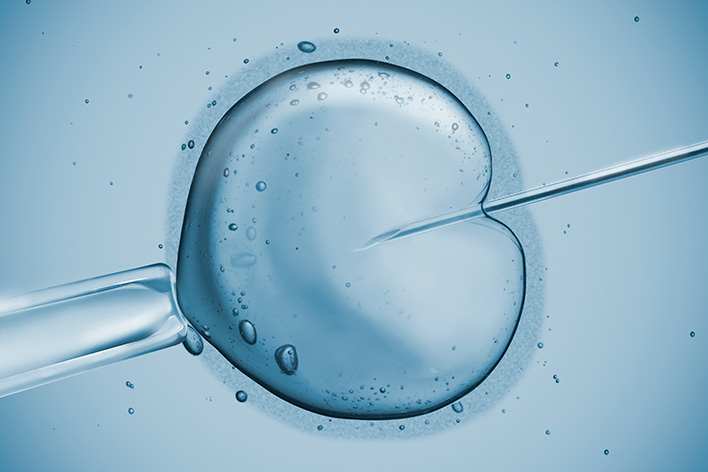
If only a few eggs develop during conventional stimulation, or only a few blastocysts form after fertilisation, the DuoStim significantly increases the yield.
In the context of preimplantation genetic testing, the number of testable embryos can be increased – and with it the chance of healthy embryos.
If oncological therapy is necessary, the limited time can be used optimally with a DuoStim to obtain as many eggs as possible.
Within 4–5 weeks we can obtain significantly more eggs than in one month with a conventional stimulation.
The woman begins her first stimulation on day 3 of her cycle. This takes a little less than two weeks.
Once enough follicles are present, the first egg retrieval is performed. The eggs are fertilised and frozen as blastocysts.
About 4–5 days after the first egg retrieval, the second stimulation begins. It again takes around two weeks and typically results in a similar number of eggs as the first.
No embryo transfer is possible after the first stimulation, because the second stimulation continues immediately afterwards. The blastocysts obtained from both stimulations are frozen and returned to the uterus in a subsequent cycle.
For a long time it was assumed that only a single group of follicles can mature per cycle. Research in recent years has changed this picture: several cohorts of small follicles are apparently recruited in the ovary in waves – including in the second half of the cycle, that is, after ovulation or after an egg retrieval.
The DuoStim makes use of exactly this observation. Instead of letting a whole month pass, a second cohort – still present in the ovary at this point – is stimulated directly after the first retrieval. For women with a severely reduced egg reserve, this is decisive: each individual stimulation yields only a few eggs, and the total number of available eggs largely determines whether a viable blastocyst develops in the end.
The available research suggests that eggs from the second, luteal stimulation are not inferior to the eggs of the first stimulation in their developmental potential. Reliable figures on the chances of success, however, depend heavily on age, egg reserve and medical history. We therefore deliberately do not quote blanket percentages, but discuss your individual starting position on the basis of your own findings.
One stimulation per cycle, one egg retrieval, followed as a rule by a break of one or more cycles. If a fresh transfer is possible, the embryo can be transferred in the same cycle – making the path to pregnancy short.
For women with a normal egg reserve, this is the proven standard path. If each stimulation yields enough eggs and blastocysts, doubling brings no additional benefit and would only be an additional burden.
Two stimulations and two egg retrievals within about four to five weeks. All embryos are frozen as blastocysts ("freeze-all"); the transfer takes place in a subsequent cycle, in which the uterine lining is built up without time pressure.
The gain lies in the numbers: more eggs in less time. This is relevant when time is short or when a single stimulation yields too few eggs for a realistic chance. The downside is a dense schedule of appointments and a higher amount of medication.
We do not recommend the DuoStim across the board. It is a tool for specific situations – and in others it is not a good idea:
We tell you clearly in advance what to expect in these weeks: more ultrasound and blood checks than with a single stimulation, two procedures in short succession, a higher amount of stimulation medication – and no embryo transfer in this cycle, because the blastocysts are frozen.
The DuoStim is not a separate form of treatment with its own set of rules, but a variant of the stimulation within an IVF or ICSI treatment. The general provisions of the Reproductive Medicine Act therefore apply:
As of 2026. Details and their practical interpretation can change – in the consultation we clarify what specifically applies to you. You can also find an overview on our page about the legal framework.
Two stimulations in four to five weeks only work when the laboratory, cryopreservation and scheduling go hand in hand. We have been a pioneer of reproductive medicine in Austria since 1982/83, co-developed the technique of cryopreservation in 1991 and work with our own on-site genetics laboratory. More than 30,000 children have been born with our support.
The effort is considerably higher: two egg retrievals, more monitoring appointments and a larger amount of stimulation medication within about four to five weeks. Many women nevertheless find it a relief to achieve the result of two cycles in one month instead of waiting over several months. We discuss realistically in advance what to expect.
The available research suggests that the eggs from the second, luteal stimulation are not inferior to the eggs of the first stimulation. They come from a further cohort of small follicles that is present in the ovary anyway. Definitive figures depend on your individual situation.
Because the second stimulation begins immediately after the first egg retrieval. The hormone doses required for it stand in the way of building up the uterine lining. All blastocysts are therefore frozen and transferred in a specially prepared subsequent cycle – an approach that has advantages in its own right.
Above all for women with a severely reduced egg reserve, for couples in whom only a few blastocysts develop from one stimulation, for treatments with planned preimplantation genetic testing and for patients for whom time is pressing – for example before oncological therapy. You can read more on our page Fertility and cancer.
Because all embryos are frozen in the DuoStim cycle as a matter of principle and no fresh transfer takes place, a major risk factor for severe ovarian hyperstimulation syndrome is eliminated. In women with a high egg reserve and a corresponding risk profile, we nevertheless do not use the DuoStim, but choose gentler concepts.
This cannot be predicted reliably. The yield depends above all on age, egg reserve (including the AMH value and the number of antral follicles on ultrasound) and the course of the first stimulation. As a guide: the second stimulation typically yields a similar number of eggs as the first. We derive concrete expectations from your own findings.
In principle yes, if it is medically sensible and you feel ready for it. Between two DuoStim treatments, we plan in a recovery phase. Whether a repetition actually improves the chances depends on what the first treatment yielded in terms of eggs and blastocysts – we assess this together with you.
Yes, this is one of the most common indications: more blastocysts mean more testable embryos and thus a higher chance of finding an unaffected embryo. In Austria, however, preimplantation genetic testing is only permitted in certain legally defined cases. We examine this together with our geneticists in our own laboratory (as of 2026).
Whether a DuoStim makes sense for you is something we are happy to clarify in a personal consultation.
Or call us: +43 1 877 77 75
Get to know our team and learn everything about the process, success rates and costs of fertility treatment – 15 minutes, free of charge and with no obligation, online or on site.
Upcoming dates