

Fertility and life planning.
Children first, then a career – or the other way round? More and more couples postpone having children until later. That “later” can often mean “too late” is something many people do not realise – and the biological clock cannot be turned back.
How you can end up missing the train.
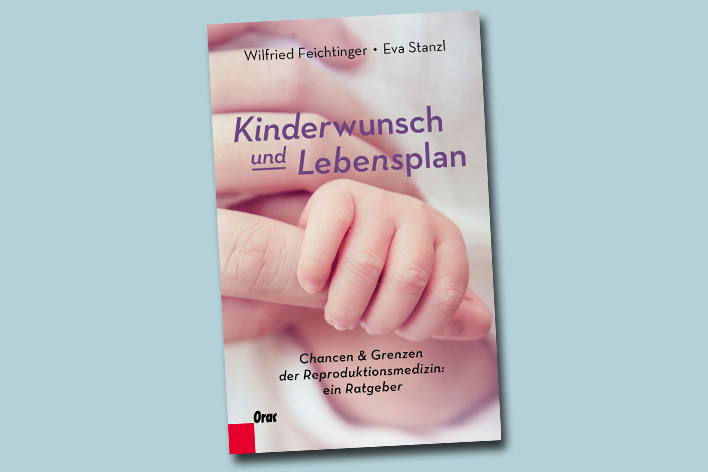
Univ.-Prof. Dr. Wilfried Feichtinger, founder of the Vienna Wunschbaby Institut, is Austria’s most renowned reproductive medicine specialist and an expert on fertility. Drawing on his wealth of experience, he has published a book intended to help women and couples find their way to family and the joy of parenthood happily – and, above all, in good time.
You can purchase the book here:
kremayr-scheriau.at – Kinderwunsch und Lebensplan
“Those who come too late are punished by life!” These harsh words originally came from Mikhail Gorbachev and have been quoted countless times in the most varied contexts. The saying also seems fitting when it comes to fertility and family planning: “Anyone who does not want to fall into the trap of involuntary childlessness would do well to think about family planning early on,” says Univ.-Prof. Dr. Wilfried Feichtinger, reproductive medicine specialist in Vienna. “The fact is: conceiving a healthy child becomes more difficult with increasing age, and even the ‘gods in white’ cannot turn back the biological clock.”
In their book “Kinderwunsch und Lebensplan” (Orac Verlag), the physician and his co-author Eva Stanzl address the challenges facing modern women and couples: careers need to be built, education completed; finding a partner is often difficult, and choosing the right partner – and future father – is more complicated today than ever before. Since the invention of the pill, women have been able to decide whether and when they want to become pregnant. On the other hand, they run the risk of falling into precisely this infertility trap – of missing the train and being left standing alone on the platform.
No problem at all?
“It’s not that dramatic!”, “No problem at all for modern medicine!” and “These days women still get pregnant at 50!” – these are the slogans whispered to childless women in their late thirties, who are slowly hearing their biological clock tick louder, by their friends. And instead of going to the doctor to have the status quo of their own fertility checked, or finally coming off the pill, they recite these mantras to their own reflection every day.
“Without passing judgement, I want to show women and couples that although reproductive medicine has come a very long way, it cannot work miracles,” says Univ.-Prof. Dr. Feichtinger, father of the first IVF baby in Austria. “Most women simply overlook or suppress the fact that even among reproductive medicine specialists the rule is: younger is better. Full stop.”
Information creates clarity
Using numerous case studies, Univ.-Prof. Dr. Feichtinger approaches the sensitive subject of family planning in his book in a gentle and realistic way. He addresses both young people, to highlight the importance of timely family planning, and older women who are still childless but wish to have children, to show them what medicine can offer. “I describe how assisted reproduction works, what possibilities it offers, but also where its limits lie,” the doctor explains. Relying on medicine alone, handing over responsibility entirely and putting family planning on the back burner is something the founder of the WIF considers counterproductive: “Family planning is the opposite of contraception,” says the expert. “Family planning does not just mean ‘preventing children’ – it also means ‘having children in good time’.”
A conscious decision
Frozen eggs, IVF, sperm banks and the like are the great hopes of the pill generation and show what medicine can do today. Statistics, however, prove that things are as they have always been: from the age of 30, women’s fertility begins to decline. From the early forties, the chance of pregnancy drops to five to ten percent per year – with or without medical assistance. Univ.-Prof. Dr. Feichtinger: “I don’t want to spread panic, nor do I want to weaken trust in reproductive medicine. I simply want to show that having a family requires a conscious decision.” At the same time, the physician warns against misplaced ambition: those who have the nursery fully furnished and the little pink socks and dresses bought before the pregnancy even begins are often disappointed. “Trying to force having a child can increase inner stress to such an extent that a pregnancy is actually prevented.”
Hard to find: the right moment
But timing is not only important for the parents – the child, too, has a right to look at the clock. In his book, Univ.-Prof. Dr. Feichtinger shows what effect it has on children when their parents are older: youthful light-heartedness versus mature experience. “The fact that so-called latecomers almost always differ considerably from their older siblings, and that this has to do with the advanced age of the parents, is well known but not really researched,” the doctor explains. Latecomers often appear more sensitive, more intelligent, calmer and more focused than their older siblings. That their parents played football with them less often or for a shorter time seems to genuinely bother very few of them.
Responding to life
The doctor sums up the core message of the book as follows: “Reproductive medicine is a blessing for infertile couples, because it can make pregnancies possible where the chances by natural means are slim. But it must never be a substitute for early life planning.”
Incidentally, in the interpreter’s words, the legendary Gorbachev quote actually translates as: “Dangers await only those who do not react to life.” And that fits family planning even better. “To avoid falling into the infertility trap, it is important not to close your eyes to reality and to act in good time,” says Univ.-Prof. Dr. Feichtinger.
Purchase the book
“Kinderwunsch und Lebensplan” by Univ.-Prof. Dr. Wilfried Feichtinger and Eva Stanzl is published by Kremayr & Scheriau (Orac).
Let’s talk.
Would you like to have the status quo of your fertility assessed? We take time for you.
Or call us: +43 1 877 77 75