
Polar body analysis (PBD)
Analysis of the egg: the polar bodies are by-products of the egg whose genetic composition allows conclusions to be drawn about the egg’s genetic material. The egg itself remains completely intact.
High pregnancy rates possible even for women over 35: with PGT we identify genetically unremarkable embryos for transfer.
A key challenge for a successful pregnancy is identifying genetically unremarkable embryos. Unfortunately, as a woman gets older, genetic abnormalities in the eggs also increase – and with them, the likelihood of a successful pregnancy decreases.
The number of eggs with genetic abnormalities is higher than many would expect.
Even after fertilisation of the egg, genetic abnormalities can occur that prevent a successful pregnancy, or genetic abnormalities could be passed on.
By means of preimplantation genetic testing (PGT), the genetic material of the egg or the fertilised embryo can be analysed during an IVF treatment in order to select genetically unremarkable embryos for transfer.
Analysis of the egg: the polar bodies are by-products of the egg whose genetic composition allows conclusions to be drawn about the egg’s genetic material. The egg itself remains completely intact.
Analysis of the fertilised embryo: a few individual cells of the trophectoderm are removed. These later develop into the placenta – the embryo remains intact.
Analysis of a known genetic variant in the fertilised embryo. Sex selection or treatment of affected eggs is not possible.
With our analyses we detect genetic changes in the eggs or the fertilised embryos and, following a genetic information session, can select genetically unremarkable embryos by means of PGT.
Various international studies (study 1, study 2) have shown that preimplantation genetic testing can significantly improve the likelihood of becoming pregnant and giving birth to a healthy child. The Wunschbaby Institut Feichtinger, led by Priv.-Doz. DDr. Michael Feichtinger, was also able to demonstrate this in a study of its own.
In addition, preimplantation genetic testing offers a host of further advantages:
Chromosome analyses of the polar bodies (PBD) are recommended for the following patient groups:
Under the Austrian Reproductive Medicine Act, the following indications permit genetic testing of the fertilised embryo:
In every case, the basic prerequisite for PGT at our institute is a chromosome analysis (karyotype) of both partners. In a genetic counselling and information session, we will be happy to discuss all your questions about preimplantation genetic testing with you at your own pace and to explore together the best approach for you.
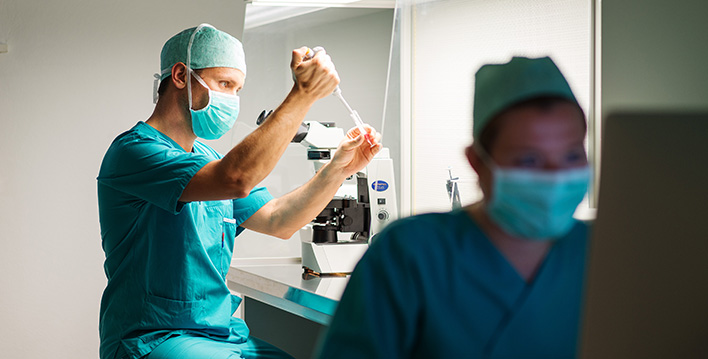
Preimplantation genetic testing examines eggs or embryos for genetic changes before the embryo transfer. This allows genetically normal embryos to be selected for transfer – the analyses are performed in our in-house WIF genetics laboratory.
We offer three approaches: polar body analysis (PKD) on the egg, chromosome analysis on the trophectoderm (TEB) of the fertilised embryo, and monogenetic analysis for a known genetic change.
No. Polar body analysis only examines the polar bodies – by-products of the egg – so the egg itself remains intact. For the chromosome analysis, only a few cells of the trophectoderm are taken, which later develop into the placenta – the embryo also remains intact.
Typical reasons are recurrent miscarriage, several unsuccessful IVF attempts, known hereditary diseases in the family or a higher age of the woman – age plays a central role in the genetic quality of the eggs.
Yes, under certain legal conditions. Whether preimplantation genetic testing is an option in your case is something we clarify together in the genetic counselling session.
No, sex selection is not possible as part of PGT at our institute.
Because the analyses are not sent to external laboratories: results are available quickly and flow directly into your treatment plan. Austria's first successful PGT was performed at the WIF in 2005.
Are you interested in preimplantation genetic testing? Book a free consultation – by phone on +43 1 877 77 75 or online.
Or call us: +43 1 877 77 75
Get to know our team and learn everything about the process, success rates and costs of fertility treatment – 15 minutes, free of charge and with no obligation, online or on site.
Upcoming dates